

It’s been nine months since I’ve declared “that Operation Saga on Fire has been concluded”, and now is finally the time that I can elaborate on what this actually means. To be direct: I made a career pivot and moved from the bustling metropolis of Tokyo to the quaint city of Kanazawa in Ishikawa prefecture. I've left the Fintech industry and am now a professional tour guide. Frankly my training and the industry gives me little room for free time. And what free time I am granted with is spent with friends, no joke, coincidentally coming to visit me! And so with that out of the way, I’d like to get right to it.
There is a notion that when you join a company in Japan as a full-time employee (正社員 or seishain), you are essentially set to work there for life until retirement. Perhaps some cultural development as a result of the Meiji restoration to placate samurai that lost their cozy allowances, this contrasts from what I perceive is as a more volatile working environment in places such as the US; layoffs are a looming threat with their 2 week notices. But I always believed that in Japan, as long as the company literally doesn’t melt from bankruptcy or that you don’t commit a criminal offence, being a seishain means living down the life of a salaryman: 40-50 years loyal to one company with salary raises that only meet to balance out inflation but reliable healthcare keeps you going before you spend your retirement years traveling around the world on a cruise, courtesy of JTB.
For the past few years at my previous company, I was aimlessly slugging myself to work, droning out, and going home on the dot at 7PM to fulfill my contractually obligated hours. For months I’ve been in a position where I haven’t had much tasks, essentially shuffled into working the “email job”, where I’d have to somehow justify my salary by stretching a 30 minute job into 9 hours. It wasn’t always this way. I did use to manage a team and lead a few projects. But after they had to be let go and market conditions worsened, I became a one-man army to sell services for one of our projects and do some research every now and then. In the morning when we each took turns reporting our tasks for the day, I always simply stated that “I’ll be corresponding to x project” (I love the versatility of the Japanese word 対応.) After finishing with a quick “以上です” (That is all), my boss with nothing to contest would go on to the next person.
I wasn’t the type to wait for my boss to leave first, but I delivered what was asked. There were lots of failed projects, but hey, it’s a Japanese company! Lots of the older staff on the team have been working for years and nothing has shaken the boat up to now. My plan was to keep this up, apply for Permanent Residency 2 years later, and then leave the company to find something else to do! I didn’t see much career growth at all, but if I could just hold on just a little bit more…
I was called into a meeting room to meet my boss the CEO. Now I could frame this like some LN-esque dialogue sequence of in single lines between me and the boss, but I’ll spare it; we did end amicably but it does pain me a bit to recall. What it boiled down to is this: I wasn’t contributing much to the company to be valuable around and in order to “just break even”, I’d have to make a certain number of “sales KPI.” I was put on a PIP and if I did not meet it, I’d be let go in January. The Seishain myth is broken. You can't just coast. They can fire you!
At the conclusion of the meeting my boss asked if I was okay. My ears rung and it felt like the whole discussion flew by fast. He made a sympathetic gesture of how “it’s a difficult topic but a necessary discussion” which coming from him I appreciated, but I nodded my head and returned to my desk. A boost of energy found me at that moment; it’s as if this is what I’ve been waiting for. While angry, I did have to agree with my boss that my stagnancy did make my value at the company questionable. But more importantly, I felt like I was working on nothing of value. He was right. In an instant, I furiously logged onto LinkedIn and began sending out resumes.
Riding on the hype from watching Zombie Land Saga: Yumeginga Paradise at Grand Cinema in Ikebukuro literally the week before the ultimatum, I wasn’t to kneel down in submission and declared my battle song Revenge by Franchouchou. Channeling the energy from Zombieland’s premise of an oddball troop of resurrected idols to hopefully bring fame to Saga City from the bottom up, I adopted their fury and declared that “Operation Saga on Fire” was a go.
"Although we have given everything in the end, and the world is pitying us, we can't forgive ourselves for not leaving any marks behind. Even if it's a battle that can't be won, our hearts will shine and won't waver. Atonement, surrender, retreat, eliminate them all. Revolution, strategy, unity, maintain them all. Disappointment, humiliation, failure, regret, burn them up all like a signal in the sky! Even if the world abandons us someday, let's keep chasing it as long as we live. Decision, obsession, restoration, resurrection. Achieve them all with our radiant souls!!!"
My big break was not on LinkedIn or Indeed, but surprisingly GaijinPot, the platform all non-Japanese speaking gaijin use to find mostly English teaching jobs. In retrospective, all LinkedIn offered was tech-related jobs that are highly competitive or ghost positions from the start. GaijinPot surprisingly offered more diverse positions other than English teaching; I even saw Pinkerton hiring. Imagine: Shibs the Union Buster!
While taking breaks for the job hunt, I just so happened to get drawn into this anime called Sakura Quest. The reason is quite simply a “return” for me to visit anime that aired during the time I decided to “hide” my power levels in university. The premise follows Yoshino Koharu, a university student nearing graduating and is having a tough time during shukatsu or job hunting (highly relatable), when she gets an opportunity to be the “queen” or PR representative for a town in the countryside called Manoyama (間野山, literally: in the middle of mountains.) One of the central concepts throughout the anime follows something called 地域おこし (chiiki okoshi) which means “regional revitalization”; an initiative to boost communities in Japan that are going through economic or social (e.g. population decline) dilemmas through subsidies, PR campaigns, and mainly tourism to uplift the region. While on the surface you see Yoshino and her friends balance the delicate relations with the local community and tourism, but you also get to see the unique issues faced in small communities: What use is an akiya (abandoned home in Japan), even with sentimental value to the community, and why can’t we just demolish it to make way for monetary opportunities? Why would a local artisanal craftsman be opposed to tourism when we are trying to give them business? Just what is the amount of red tape to get through to establish a B&B (民宿) in Japan?
This unique premise had me interested, probably as I was much jaded to the city life, when I came across a job posting in the tourism sector: A tour company that focuses on partnering with local companies and sustainability and… the whole SDG complaint spiel. I won’t lie that the latter is noble, but it always rubbed me the wrong way particularly in Japan in 2016 onward when even construction sites had these banners that demonstrated how the future building will serve the community; I always found that you can fit any SDG to practically any business (pretty sure I saw some bougie place by Marunouchi that was probably some investment bank that had three of the goals like ‘no poverty’, decent economic growth’, and ‘innovation and infrastructure”.) Regardless, I thought it would be interesting to work in an industry that was less digital, and more involved to embed with communities. I sent my application, and decided to have a pivot to tourism. I applied to a few other companies and started practicing for interviews. A few interesting mentions were extreme travel companies that were seasonal and would have me in the deep mountains for at a time and an anime-related company that paid low but was located in Akihabara so I was willing to take the hit.
With good momentum and already a few replies in only half a month, I decided R&R was in order. My cousin recently completed medical school and wanted to vacation in Japan before he started work. He had a dream of golfing right by Mt. Fuji, and he asked for my help to arrange this in return for me golfing with him for free. I un-apologetically took PTO and spent a weekend in Gotemba. Right near the base of Mt. Fuji is a golf course called Gora Kadan and I spent the day with my cousin and his girlfriend golfing, and went cycling in the late afternoon around Lake Yamanaka; there was also a JSDF base nearby and every now and then I would hear what I assume was artillery shots going off that sounded like thunder. It was the taxi back from Lake Yamanaka when I got the email.
“Mr. Shibs, we reached out a few days ago. Are you still interested in applying at our company?”
My heart dropped, and I calibrated myself to figure out which company this was. It turned out to not be my preferred company: a position open for a tour guide... but I was not going to squander any application over laziness. Despite the bumpy ride back, I crafted a reply on my phone, and days later I find myself interviewing with them. As any interview goes, my heart was beating fast beforehand, but there was a sense of “going through the motions” that eased my heartrate and let me finish my interview in a cathartic state.
Not too long later, I find myself at the Tokyo Station Hotel for a face to face interview with the CEO and another staff member who I later found out is basically the operations head. I stumbled inside in my Uniqlo non-iron shirt and kandou pants, covered overall with my relatively cheap blended wool coat on in the early December cold and was 20 minutes early. The hotel was out of my tax bracket with bellboys in their hats darting around, and the first floor cafe having coffee that costs 1,500 yen. When the two arrived and we got pleasantries out of the way, the usual expected questions were asked: over-tourism in Japan, my thoughts on certain unexplored regions in Japan, my guesses on the next demographics of tourists that would visit Japan. My rigorous practice beforehand had me unphased with any question, but when I found out that the CEO was from Nagano, I had to flex my knowledge from my primary source of all things Japan: Shogun 2 Total War. I brought up a backpacking adventure I did back in New Year’s Eve 2021 where I bought a seishun juhachi kippu (青春18きっぷ) and aimlessly went west from Tokyo, stopping by Lake Suwa, and staying a night at Matsumoto; where I spent New Year’s eve enjoying the illumination on the castle and settling on bentos at NewDays since no restaurants were open. The next day I went to Nagano city itself and spent my hatsumode at Zenkoji, and mentioned how I signed up for a LARP event around the battle of Kawanakajima but got cancelled due to COVID. I then talked about Takeda Shingen and Uesugi Kenshin, then perhaps Shishu noodles or apples… but when my ramblings ended the interview went back to business. The position would have me relocate to Kanazawa City in Ishikawa Prefecture. I do have a distant relative that lives there, and I did rationalize a break from a big city would help my mental health. I’ve visited once and went to the usual: Kanazawa castle, Kenrokuen (garden), and Higashi Chaya (geisha district.) “How do you feel about Takayama… or how do you feel about working in our headquarters in central Japan?” the CEO asked. I pondered, and wondered if this was a trick question to see how desperate I was. Takayama is a lot smaller and remote, so that would be great to truly live some life detached from modern worries (in exchange for the inconveniences in a rural environment.) The headquarters also was interesting to still utilize my business degree; I personally would have said “whichever I would fit best for the company.” However, I ultimately insisted on Kanazawa saying along the lines that “I applied for Kanazawa and want to commit to it.” I know that if I took the job, I’d be leaving my life in Tokyo. No more weekend daytrips for seichi junrei (spoiler alert: I was dead wrong here!), clubbing at Mogra for Anison Matrix, and the convenience of flying back home easily. But I didn’t mind, anywhere but Tokyo would be beneficial for my health. The interview wrapped and after thank-yous, I exit to a drab winter Marunouchi Plaza and make way to catch a train to my office. After one more interview a few days later, the results came in: I got an offer.
I continued to interview at different companies while I was still in the negotiation phase for my salary and start date at this potential prospect. Much to my surprise, i got a few more offers. My side gig was willing to have me come full-time, but let’s just say the visa sponsorship technicalities made it sketchy, and more importantly the first company that got me into the tourism pivot actually made me an offer. I applied to 31 companies, had 6 first interviews, and down the funnel received 3 job offers. I ultimately went with not my first pick, but the Kanazawa job.
When I sent my cover letters and resumes to two of the companies that offered me a job, I quoted Sakura Quest as an inspiration and listed “seichi junrei” as my “skill.” Considering I got offers when I mentioned anime, statistically you could say anime got me my job. Takeaway lesson when job hunting? Mention anime during your job interview!
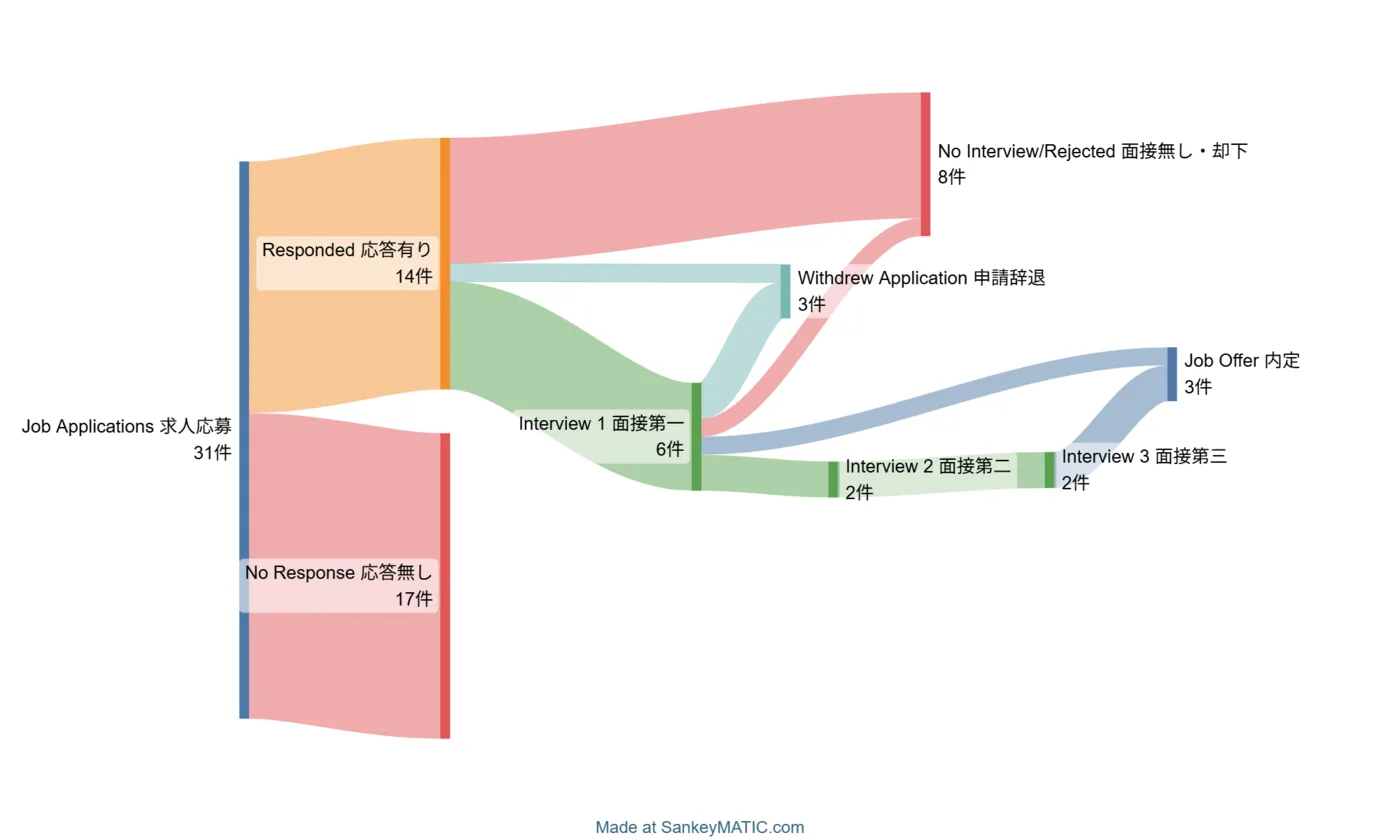
Anime got me a job
I reviewed the deliverables: a full-time tour guide. Salaried, so even on off-seasons I'd have steady income. When not during tours, I make new tours, do usual office work (not the spreadsheets!), and create written content for the website. I accepted the job and after many weeks, could finally loosen my shoulders.
Looking forward, I was now set to relocate to Kanazawa. Other than a trip in January to apartment hunt, where I met my future manager, I rigorously re-played Shogun 2 as the Ikko-Ikki. Little did I know most of the average Kanazawa-jin looks more fondly post-Ikko-Ikki when the Maeda clan took over power during the Edo period and tends to view the Ikko-Ikki era as a cultural “dark age.”
I wrapped up my affairs in Tokyo, ended rather amicably with my company and spent my free remaining days to do seichi junrei in a couple of locations: Tachikawa for the Polar Research Institute from that brief segment from Sora Yori mo Tooi Basho (and my new goal of visiting all Japanese ice breakers. Started with the Soya, Shirase 5002, and the Fuji. All I need know is the Shirase 5003.), Mizuho for Clannad, and Chichibu for Ano Hana. I also for some reason so happened to visit the neighborhood of my first apartment in Japan in Kodaira-shi (new ramble?)
A bunch of farewell parties later, I boarded the Hakutaka on the Hokuriku Shinkansen and began my new life in Kanazawa.

Hokuriku Core. Anime that takes place around where I live. Already conducted holy pilgrimages! Top to Bottom, Left to Right: Hanasaku Iroha, Angel Beats!, Sakura Quest, Koi Tabi: True Tears Nanto, Love Live! Hasunosora Girls' High School Idol Club Bloom Garden Party, Yuru Yuri, True Tears, Wolf Children, Glasslip
A separate ramble is deserved for the city of Kanazawa, but I went through on-boarding and started to make new connections. My new favorite bar is tucked in a certain alley right along Betsuin-dori; named since the street housed both rival branches of the Jodo Shinshu (Ikko-Ikki!) and was the old nightlife center pre-bubble. I also learned of the variety of unique Ishikawa food, my personal favorite being Kanazawa Curry. I get dispatched beyond Ishikawa to neighboring prefectures: Fukui, Toyama, and even south in Gifu! This job surprisingly educated me on niche topics. I can talk much more about Buddhism and go into detail about a few bousatsu and even different sects of Buddhism. Of course I am pretty much well-versed with the basic history of Kanazawa, I can talk about the 1800s rice riots, go on a tangent about geisha, and even talk about the layout of the former Ninomaru Palace (now being reconstructed!) Even outside of Ishikawa, I have some basic memorized scripts to talk about the basalt rock formations that line up Fukui prefecture, the four dinosaur speicies discovered in Katsuyama, sericulture and papermaking in the mountains of Gokayama, and talk about the cost of how much to rethatch a roof at Shirakawago (50,000 USD for half a roof, already subsidized by UNESCO.) History was always my favorite subject, so now most of my skills rely on rapport building.
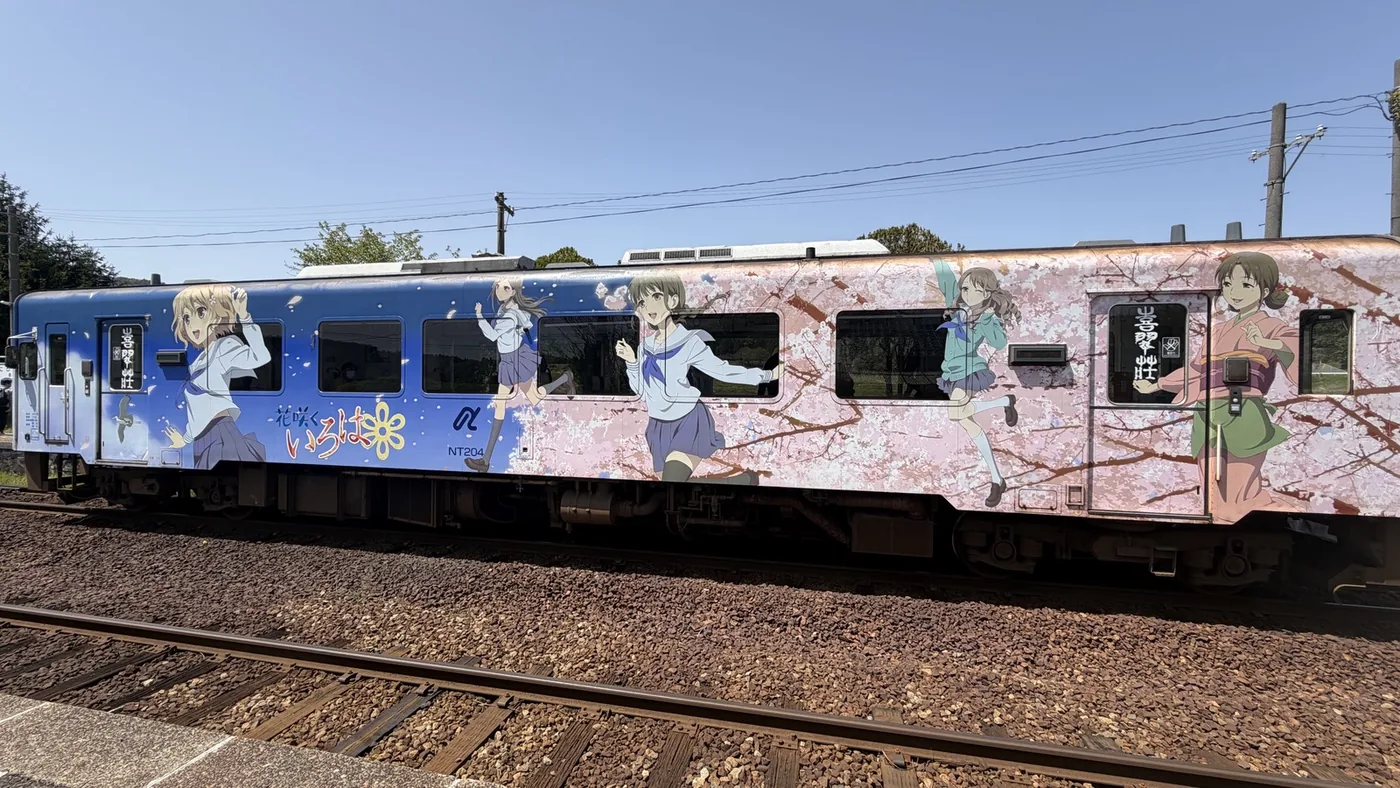
Photo I took of a Hanasaku Iroha-wrapped train at Nishigishi Station
When off work, I try to explore around the countryside and I discovered a gold mine: seichi junrei locations all across the region! Whether it be my home turf having a huge number of anime set, Yuwaku Onsen in the east for Hanasaku Iroha or Kanazawa University being the model for the massive school in Angel Beats, or even distant locations like Mikuni for Glasslip or Sakura Quest itself in Nanto City in Toyama, I am in a treasure chest for seichi junrei. I’ll definitely make more updates of my travels; I want to go into more detail for each location.
If I had to describe what my job is like, the office work behind the scenes and interacting with local businesses really reminds me of Sakura Quest. Whenever I walk pass by a local business, I always feel a sense of recognition when the shopkeep goes "Oh hey, Mr. Guide! Thank you for always dropping by." The guiding aspect mindconfuses me like its Aria the Animation.

Gotta revitilize!!!

Comfy
From Kanazawa Station, I took a one hour bus in early April to visit a close friend that I used to work with in Tokyo. He used to also work in a startup environment like me and it seems he also grew tired of it. He now lives in Inami, dubbed “one of the quietest places in the world” according to Conde Naste and is known for its woodcarving culture. It was actually featured in Sakura Quest for the “woodcarving district” and my friend is an aspiring woodcarver. The bus went through mountains and endless tunnels before I ended up in the heart of Nanto City. We met a bit further south near his workplace and had lunch by the river. The sakura petals were fluttering as a breeze comes in, and the contrails of small planes that passed above every now and then. It was a brief chat as he was on his lunch break. We just caught up since we haven’t spoken in years, and he recommended me a bunch of local establishments such as a meat shop, a silk weaving center, and a farm. When we parted, I took the local train further south to its end at Johanna Station. I realized that this is the very station in Sakura Quest that Koharu got off in episode one, though being referred to as Manoyama Station. I went to the tourist information center right next to the station, rented a bicycle, and went up the hill to a place called Sakuragaike: where the “Chupacabra kingdom” in the anime is set. I rested at a cafe next to the PA Works (bravo!) headquarters and purchased some goods. I cycled around, baffling probably anyone who saw me as to why this baka gaijin has a smile from ear to ear while going around in the middle of nowhere. There was nothing other than the trail, and the sakura were surprisingly not that eye-catching. It was peaceful, and that's all I could ever ask for.
I am unsure what the future holds, but at the end I take pride that I’ve made it here by myself.
A few weeks into my job, I had a chat with my manager about how I did during my application process. He told me that after my Tokyo interview, the CEO sent a message to him: “I think we found someone.”
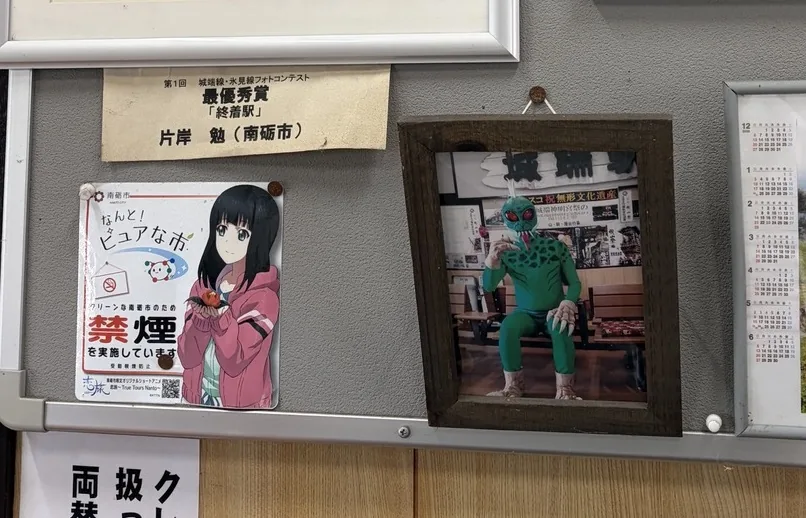
"There are unknown paths, futures not on my map... But even if I get lost, if I can find them all along the way, keeping my own pace, I wonder if some of it will start to make sense."
 RSS
RSS